
Having two checking accounts means intentionally splitting your cash flow into two separate pools of money that serve different purposes. The point is not to have more accounts but to create boundaries that your brain and your calendar can follow. One account typically serves as a stable, protected hub for fixed or semi-fixed obligations, while the other is designed for the messy, day-to-day reality of spending. This approach becomes more attractive when you have multiple bills hitting on different days, income that doesn’t arrive in one neat monthly deposit, or spending patterns that make it hard to trust the available balance in one account. The most common structure is a bills account plus a spending account. In this system, the bills account is where rent or mortgage, utilities, insurance, subscriptions, debt payments, and other predictable obligations live. The spending account becomes the everyday account for groceries, gas, dining out, personal purchases, and anything else that fluctuates. Another popular structure is an income account plus an operating account. Think of the income account as a landing pad where paychecks or client payments arrive. Then, you transfer a set amount to the operating account—your working money for bills and spending—on a schedule that creates consistency. This setup is especially useful for freelancers, commission earners, or anyone with unpredictable income because it turns irregular inflows into controlled outflows. Instead of letting your spending rise and fall with every deposit, you choose a “pay yourself” rhythm and amount. Visual separation reduces temptation because your brain responds differently to boundaries than to internal promises. When all money sits in one pool, the number on the screen feels like permission. Even if you know some of it is reserved for bills, the balance still reads as available. Two accounts change that. The spending account becomes the account you’re allowed to use, and the bills account becomes the account you’re not supposed to treat as spendable. Limiting spending to a preset allowance account turns budgeting from a constant decision into a single decision repeated consistently. Instead of deciding whether you can afford something every time, you decide once: “This is my spending money for the week.” Then the account balance does the policing for you. That reduces decision fatigue and makes behavior more consistent. People who struggle with impulse spending often do better with clear constraints than with flexible plans. A dedicated bills account reduces “oops” spending because it removes the opportunity for accidental overlap. Bills are not just big expenses; they’re time-based events. Two accounts help you respect timing. If your rent hits on the first, your insurance on the 12th, and your phone bill on the 20th, the system keeps those commitments insulated from a random expensive weekend on the 9th. This structure also stabilizes cash flow when bills hit between paydays. Many people aren’t broke; they’re mistimed. Their income arrives, their bills arrive, and the order doesn’t always cooperate. With two accounts, you can fund the bills account ahead of time based on the month’s schedule, so the timing becomes predictable. That predictability reduces stress and reduces the need for last-minute transfers that can fail or arrive late. Keeping a buffer in the bills account creates a shock absorber for the real world. Bills change, taxes fluctuate, and utilities spike. A buffer helps your system tolerate those swings without collapsing into overdrafts. When your bills account has a cushion, a slightly higher electric bill doesn’t trigger a chain reaction that forces you to move money around or miss a payment. Aligning bill due dates with deposit timing becomes easier when you have a dedicated account for obligations. You can schedule transfers into the bills account to occur immediately after payday, and you can schedule autopay drafts to pull only from that account. That creates a clean rhythm. Instead of bills pulling from the same place as your daily spending, bills pull from the account whose entire purpose is to be ready when bills arrive. Putting household bills in one place reduces ambiguity. When shared expenses are scattered across personal accounts, it’s hard to know what’s fair, what’s paid, and what’s coming next. A joint bills account creates a shared dashboard. Both people can see what’s due, what cleared, and what remains, which lowers the chance of duplicating payments or missing them. Transparent, predictable contributions can also reduce conflict. When the system says, “We each transfer X on payday,” you remove the emotional negotiation from recurring expenses. It becomes a rule rather than a discussion. Couples often find that clarity reduces resentment because both people can see the structure and the outcomes. Autonomy becomes easier when shared responsibilities are clearly funded. Two accounts can offer faster insight into what’s safe to spend. Instead of looking at one big balance and doing mental subtraction, you look at the spending account and treat it as your limit. That clarity can help you make decisions quickly without guessing. It becomes easier to say yes to something when you actually can and easier to say no when you can’t. Cleaner categories also help with reviews and organization, including tax-time organization where relevant. If you have a side business, reimbursements, or irregular income, separating certain flows can make it easier to track what happened without reconstructing a month of transactions. Even without a business, separate accounts can help you spot patterns, such as lifestyle creep, because variable spending becomes visible in one place instead of mixed with everything else. Monthly maintenance fees are the most obvious risk. Some banks charge a fee unless you keep a minimum balance, set up direct deposit, or maintain a certain number of transactions. If you add a second checking account that triggers a second fee, you can pay for the privilege of budgeting. That defeats the purpose. Minimum balance traps are another common problem. People open a second account to separate money, then feel forced to keep a larger idle balance than they want to avoid fees. That can reduce flexibility, especially if you’re building an emergency fund or paying down debt. The system should create efficiency, not lock money away in non-productive minimums. ATM network differences and out-of-network fees matter more than people expect. If one account’s debit card is tied to a bank with weaker ATM access, you can end up paying fees for routine withdrawals. Those fees add up quietly. When people dislike their new system, it’s often because daily friction costs them money. More accounts means more admin. There are more logins to check, more statements to review, and more opportunities to miss something. If you already feel overwhelmed by finances, a second checking account can feel like another chore unless the system reduces your workload through automation. Manual transfers can break the system because humans are inconsistent. If the plan requires you to move money at exactly the right time each week, eventually you’ll forget, get busy, or assume you’ll do it later. Then the spending account gets low, you dip into the bills account, and the separation collapses. Timing mistakes can create shortfalls even when you “have the money.” Transfers can take time, especially between different banks. Autopay drafts can hit earlier than expected. If your bills account is underfunded for even a day, you can trigger late fees, returned payments, or overdrafts. The system must be designed with timing in mind, not just totals. A spending account can run dry, especially if you treat it like a debit card leash. When it hits zero, you may feel stuck even though you have money elsewhere. That frustration can lead people to constantly transfer “just a little more,” which turns the spending boundary into a suggestion. The solution is to set realistic spending funding and to include a small flex category rather than pretending variability doesn’t exist. A bills account can also get hit by unexpected auto-drafts. Subscriptions renew, trial periods end, annual fees hit, and a “predictable” bill becomes unpredictable. If you treat your bills account as a tight, exact number, one surprise draft can cause a domino effect of failed payments. Alerts and buffers matter because they’re the safety rails. Without them, two accounts can produce a false sense of security. The system works best when you assume small surprises will happen and you build in enough cushion that those surprises don’t break your plan. Two checking accounts can mean two debit cards to protect. Debit cards are convenient, but they also expose your cash directly. Having more debit cards in circulation can increase the number of points where fraud or loss can occur. Even if the risk increase is small, the hassle of monitoring and replacing cards is real. More accounts can mean more potential exposure points, especially if you use one account for online subscriptions and the other for daily swipes. If you’re not careful about where each card is used, you can end up spreading risk rather than containing it. A clean system often involves minimizing debit card usage where possible and leaning on safer payment methods for certain categories, while keeping the bills account insulated. Misaligned expectations can turn a two-account system into a relationship issue. One person may view the joint account as strictly bills, while the other treats it as shared lifestyle spending. If the boundaries aren’t explicit, conflict can follow because each person thinks they’re following the plan. A lack of clarity about who funds what and when is another common problem. If contributions are not standardized, one person may feel they’re carrying the load or may get anxious when bills approach. A shared account works best when funding rules are agreed on and automated, so it doesn’t become a repeated conversation. Defining what qualifies as bills should include fixed and predictable expenses. Rent, utilities, insurance, debt payments, subscriptions, childcare, and any routine financial obligations typically belong here. The key is that these expenses either must happen or are highly likely to happen. If you know you will pay it, it should be funded. Defining spending should include variable, discretionary, and day-to-day costs. Groceries, gas, dining, personal shopping, entertainment, and miscellaneous items belong here. The point is to keep this category flexible but bounded. Spending is where lifestyle choices live, and it’s where people are most likely to overshoot if boundaries are unclear. Using the same bank can make transfers instantaneous and make the system easier to manage. If your bank lets you nickname accounts, set alerts, and schedule recurring internal transfers, you can create a smooth experience. Same-bank setups reduce timing risk and reduce the chance you’ll forget a transfer because it feels like moving money between “pockets.” Using different banks can be helpful when you want friction or when one bank is better for bills and another is better for spending. Some people intentionally keep bills at a bank they don’t carry in their wallet, which reduces temptation. The tradeoff is transfer speed and complexity, so this approach works best when you maintain larger buffers and avoid tight timing. Fee-free accounts and ATM access should be treated as essential. The second account should not cost you money to exist. If it does, you should strongly consider alternatives, such as switching banks, using a savings account, or using a bank that offers multiple free checking accounts. Fast transfers and instant availability matter if your system relies on timing. If a transfer takes two business days and your rent drafts tomorrow, the system can fail even if your plan is correct. This is why most reliable setups either keep both accounts at the same institution or maintain buffers large enough that transfers are rarely urgent. Direct deposit split is ideal if your employer supports it because it funds the system before you even touch the money. When a set amount goes to bills and a set amount goes to spending, your budgeting becomes default. You’re not choosing discipline each payday; the structure happens automatically. Scheduled transfers on payday can accomplish the same goal when direct deposit splitting is not available. The key is to match the transfer schedule to your income schedule. If you’re paid biweekly, the transfer should happen biweekly. If you’re paid weekly, weekly. Automation should mirror reality. Auto-pay should come from the bills account only. This rule protects you from accidental overlap. When bills pull from the same account as daily spending, you are always at risk of spending money that autopay expects to exist. Keeping bills centralized also makes it easier to audit what you’re paying and to spot subscriptions you no longer want. A minimum safe cushion protects your bills account from surprises. Many people find the system works best when the bills account is never funded to the exact dollar. Instead, it carries a stable buffer that covers variability and prevents overdrafts. The exact number depends on your bill volatility, but the principle is consistent: the bills account should be resilient. Annual and irregular expenses need a plan, or they will ambush you. Insurance paid quarterly, annual subscriptions, gifts, car repairs, and travel don’t fit neatly into monthly bills. If you don’t account for them, you’ll keep “borrowing” from the bills account, which undermines the separation. A strong system either builds those into a predictable monthly set-aside or routes them into a separate savings bucket. Using one debit card for spending only creates a clean boundary. If your spending account’s card is the only one you carry, your bills money becomes naturally protected. This approach also reduces the chance that a compromised debit card drains the account that holds your critical obligations. Locking or freezing the bills debit card, if possible, is a practical risk-reduction move. If your bank allows you to disable the card temporarily, you can keep it off most of the time. That reduces fraud exposure and reduces the temptation to dip into the bills account for “just this once” spending. Digital wallet and card controls can add another layer of security. Many banks let you set transaction alerts, restrict international purchases, or limit certain merchant types. These features can make a two-account system safer and more reliable, especially if you’ve dealt with fraud before. Two checking accounts is a smart move when your biggest financial problem is not earning enough interest or optimizing rewards, but managing timing, behavior, and reliability. If you regularly worry about whether your balance is truly available, if bills feel like ambushes, or if spending boundaries dissolve inside one account, separation can make your money life calmer and more predictable. One checking account is enough when your bill timing is already stable, your buffer is healthy, and your spending is disciplined. If you’re already using automation, tracking effectively, and you don’t experience overdrafts or missed payments, a second checking account may add complexity without improving outcomes. If you’re considering this strategy, it can be wise to consult a financial advisor who can review your cash flow, bill schedule, debt structure, and savings goals. A good advisor can help you choose an account structure that matches your income pattern and reduces risk, especially if you have variable income, shared finances, or a history of overdrafts.What It Means to Have Two Checking Accounts
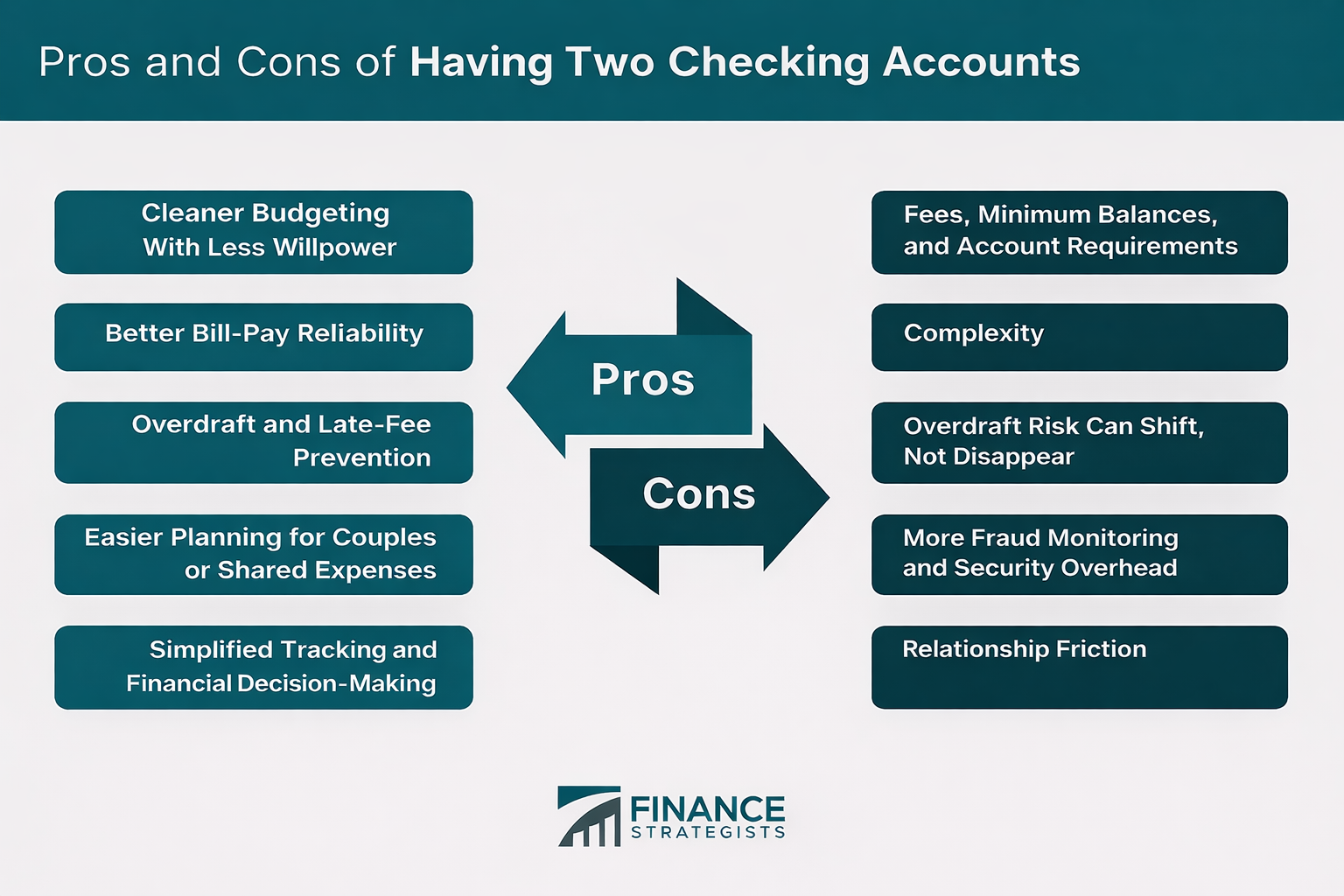
The Pros of Having Two Checking Accounts
Cleaner Budgeting With Less Willpower
Better Bill-Pay Reliability
Overdraft and Late-Fee Prevention (When Designed Right)
Easier Planning for Couples or Shared Expenses
Simplified Tracking and Financial Decision-Making
The Cons of Having Two Checking Accounts
Fees, Minimum Balances, and Account Requirements
Complexity
Overdraft Risk Can Shift, Not Disappear
More Fraud Monitoring and Security Overhead
Relationship Friction (When Used for Joint Money)
How to Set Up Two Checking Accounts the Right Way
Step 1: Choose the Roles (Bills vs. Spending)
Step 2: Pick Banks and Account Types Strategically
Step 3: Automate the System
Step 4: Build Buffers to Prevent Breakage
Step 5: Decide How to Use Debit Cards
Bottom Line
Pros and Cons of Having Two Checking Accounts FAQs
Two checking accounts can be better than a budgeting app for people who struggle to track digital categories when money is still in a single pool. An app tells you what you should do, but it doesn’t physically prevent you from spending. Two accounts change the environment by making spending limits tangible. The best approach often combines both: the accounts create boundaries, and the app provides visibility.
Checking accounts generally do not affect your credit score because they are deposit accounts, not credit accounts. Opening a checking account may involve identity verification and, in some cases, a soft inquiry, but it typically does not change your credit score the way a new credit card might.
Keeping both accounts at the same bank is often the simplest and most reliable choice because transfers tend to be instant and easier to automate. It also makes monitoring easier because everything is visible in one login. Using different banks can be useful if you want friction or if one bank offers better features for one account’s role, but it increases timing risk and requires stronger buffers.
A bills buffer should be large enough to handle normal variability and small surprises without requiring emergency transfers. The right number depends on how volatile your bills are and how close your timing runs.
Yes, and for many people it’s the cleaner option. A savings account can serve as the protected bucket, especially when the money is not needed for frequent transactions. If your bank allows quick transfers and you maintain appropriate timing and buffers, one checking plus savings can deliver the same behavioral benefits with fewer fees and better interest potential.
True Tamplin is a published author, public speaker, CEO of UpDigital, and founder of Finance Strategists.
True is a Certified Educator in Personal Finance (CEPF®), author of The Handy Financial Ratios Guide, a member of the Society for Advancing Business Editing and Writing, contributes to his financial education site, Finance Strategists, and has spoken to various financial communities such as the CFA Institute, as well as university students like his Alma mater, Biola University, where he received a bachelor of science in business and data analytics.
To learn more about True, visit his personal website or view his author profiles on Amazon, Nasdaq and Forbes.