
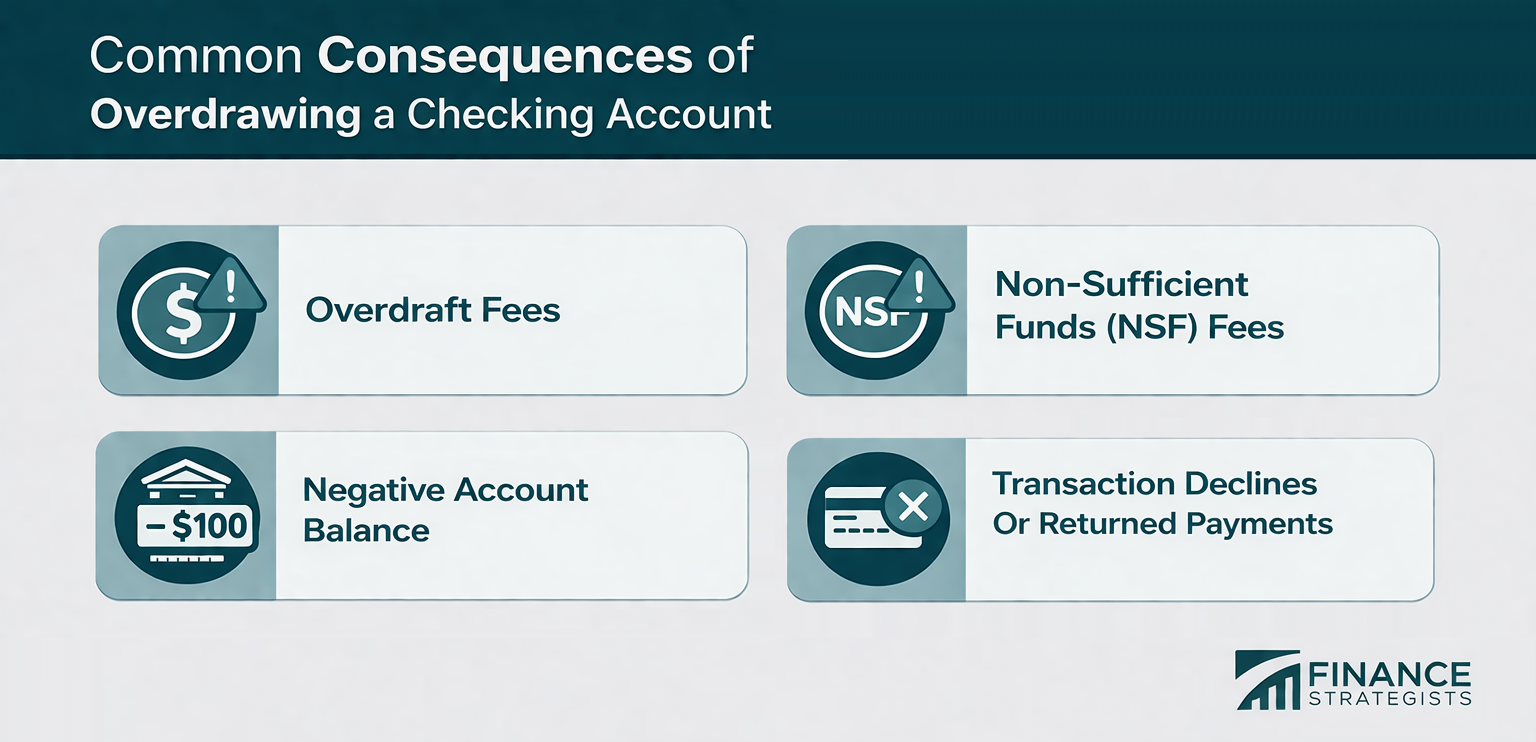
When you overdraw your checking account, your balance drops below zero because more money has been withdrawn than is available. At that point, your bank must decide whether to approve or decline incoming transactions. If the bank approves them, it effectively covers the difference and typically charges an overdraft fee. If it declines them, the transaction fails, but you may still incur a non-sufficient funds fee. At the same time, your account reflects a negative balance that must be repaid. If the balance remains negative, additional fees may apply depending on the bank’s policies. While the situation may seem minor at first, it can become costly if not addressed promptly. One of the most immediate consequences is the overdraft fee. Banks commonly charge between $25 and $35 each time a transaction pushes your account further into the negative. If multiple transactions occur while your account lacks sufficient funds, each one can generate its own fee. This means a single overdraft event can quickly turn into a much larger expense than expected. In addition, some banks impose daily fees for accounts that remain overdrawn for multiple days. Even a small negative balance can become increasingly expensive if it is not corrected quickly, as these fees continue to accumulate over time. If a transaction is declined due to insufficient funds, the bank may still charge a non-sufficient funds fee. This often applies to checks, automatic bill payments, or recurring subscriptions. Although the payment does not go through, the fee can be comparable to an overdraft charge, making the financial impact similar despite the different outcome. Once your account is overdrawn, the negative balance represents money owed directly to the bank. This balance includes not only the original shortfall but also any fees that have been applied. Until you deposit enough funds to bring the balance back to zero or above, your account remains in a restricted state, and additional penalties may continue to apply. Overdrawing your account can disrupt your financial routine in noticeable ways. Debit card purchases may be declined, checks may be returned, and scheduled bill payments may fail. These disruptions can create a ripple effect, leading to late fees, service interruptions, or complications with service providers. What begins as a single overdraft can quickly extend into multiple areas of your financial life. If your account remains negative for an extended period, typically between 30 and 60 days, your bank may close it. Once the account is closed, you lose access to it entirely, but you are still responsible for repaying any outstanding balance. Reopening the account is often not an option, especially if the closure was due to prolonged nonpayment. If the negative balance remains unpaid, the bank may transfer the debt to a collections agency. At this stage, repayment efforts become more aggressive, and additional fees or interest may be added. The situation also becomes more stressful, as collection agencies actively pursue payment and may contact you repeatedly. Banks use reporting systems such as ChexSystems to track account behavior. If your account is closed due to overdrafts, that information may be recorded and shared with other financial institutions. This record can remain for up to five years and may make it difficult to open a new checking account in the future. As a result, you may be forced to rely on alternative financial services that are often more expensive and less convenient. Although rare, legal consequences can arise in cases involving intentional misuse, such as knowingly writing bad checks or engaging in fraudulent activity. For most people, accidental overdrafts do not lead to legal trouble, but ignoring the issue entirely can increase the risk over time. The most direct solution is to deposit enough money to bring your balance back to zero or higher. Doing so stops additional fees from accumulating and restores your account to normal status. Even a partial deposit can help reduce the negative balance and demonstrate to your bank that you are actively resolving the issue. Reaching out to your bank can often lead to better outcomes than expected. Many banks are willing to waive overdraft fees, particularly for customers with a strong account history or those experiencing a first-time overdraft. A simple conversation can potentially save you a significant amount in fees. If there are transactions that have not yet fully processed, you may be able to cancel or delay them. This can prevent additional overdraft fees from stacking on top of the existing balance. Timing matters, and acting quickly can make a meaningful difference. Setting up account alerts provides an early warning system for low balances or large transactions. These notifications help you stay aware of your account activity and reduce the likelihood of future overdrafts. With consistent monitoring, you can catch potential issues before they escalate. Overdraft protection allows your bank to transfer funds from a linked account, such as a savings account or line of credit, when your checking account runs low. This can prevent transaction declines and reduce or eliminate overdraft fees, depending on the protection's structure. Some people prefer to disable overdraft coverage entirely, ensuring that transactions are declined if sufficient funds are not available. While this may be inconvenient in the moment, it prevents the accumulation of costly fees and keeps your account from going negative. Many overdrafts occur because of a gap between perceived and actual account balances, especially when pending transactions are not considered. Regularly reviewing your account activity helps you maintain an accurate understanding of your finances and avoid unexpected shortfalls. Keeping a small cushion in your account provides an additional layer of protection. Even a modest buffer can absorb unexpected charges and reduce the likelihood of overdrafting. Over time, this simple habit can significantly improve financial stability. Overdrawing your checking account is not uncommon, but it can become expensive quickly if left unaddressed. The true risk lies not in the overdraft itself, but in the chain of consequences that can follow. Fees can accumulate, accounts can be closed, and access to future banking services can become limited. The key is to act quickly, communicate with your bank, and put preventative measures in place. With the right approach, an overdraft can remain a temporary setback rather than a long-term financial issue. Awareness, timely action, and consistent account management are what ultimately keep small mistakes from becoming larger problems.What Happens When You Overdraw Your Checking Account?
Common Consequences of Overdrawing a Checking Account
Overdraft Fees
Non-Sufficient Funds (NSF) Fees
Negative Account Balance
Transaction Declines Or Returned Payments
What Happens If You Don’t Fix an Overdrawn Account
Account Closure
Collections Activity
Impact On Your Banking History
Potential Legal Issues
How To Fix An Overdrawn Checking Account
Deposit Funds Immediately
Contact Your Bank
Stop Pending Transactions
Set Up Alerts
How To Avoid Overdraft Fees In The Future
Use Overdraft Protection
Opt Out Of Overdraft Coverage
Track Your Spending Regularly
Maintain A Buffer Balance
Final Thoughts
Consequences of Overdrawing a Checking Account FAQs
The amount you can overdraw typically depends on your bank’s overdraft limit, which is often based on your account history and relationship with the institution.
In most cases, overdrawing your checking account does not directly affect your credit score. However, once a collection account appears on your credit report, it can significantly lower your credit score and affect your ability to qualify for loans, credit cards, or housing.
Accidental overdrafts do not result in jail time. Legal consequences are generally limited to situations involving intentional fraud or knowingly writing bad checks.
Most banks allow a negative balance for a limited period, typically between 30 and 60 days, before taking action such as account closure. The exact timeframe depends on the institution, but resolving the issue as soon as possible is always the safest course.
Many banks are willing to waive overdraft fees, especially for first-time incidents or customers with a positive account history. Contacting your bank directly often improves your chances of receiving a refund.
True Tamplin is a published author, public speaker, CEO of UpDigital, and founder of Finance Strategists.
True is a Certified Educator in Personal Finance (CEPF®), author of The Handy Financial Ratios Guide, a member of the Society for Advancing Business Editing and Writing, contributes to his financial education site, Finance Strategists, and has spoken to various financial communities such as the CFA Institute, as well as university students like his Alma mater, Biola University, where he received a bachelor of science in business and data analytics.
To learn more about True, visit his personal website or view his author profiles on Amazon, Nasdaq and Forbes.