
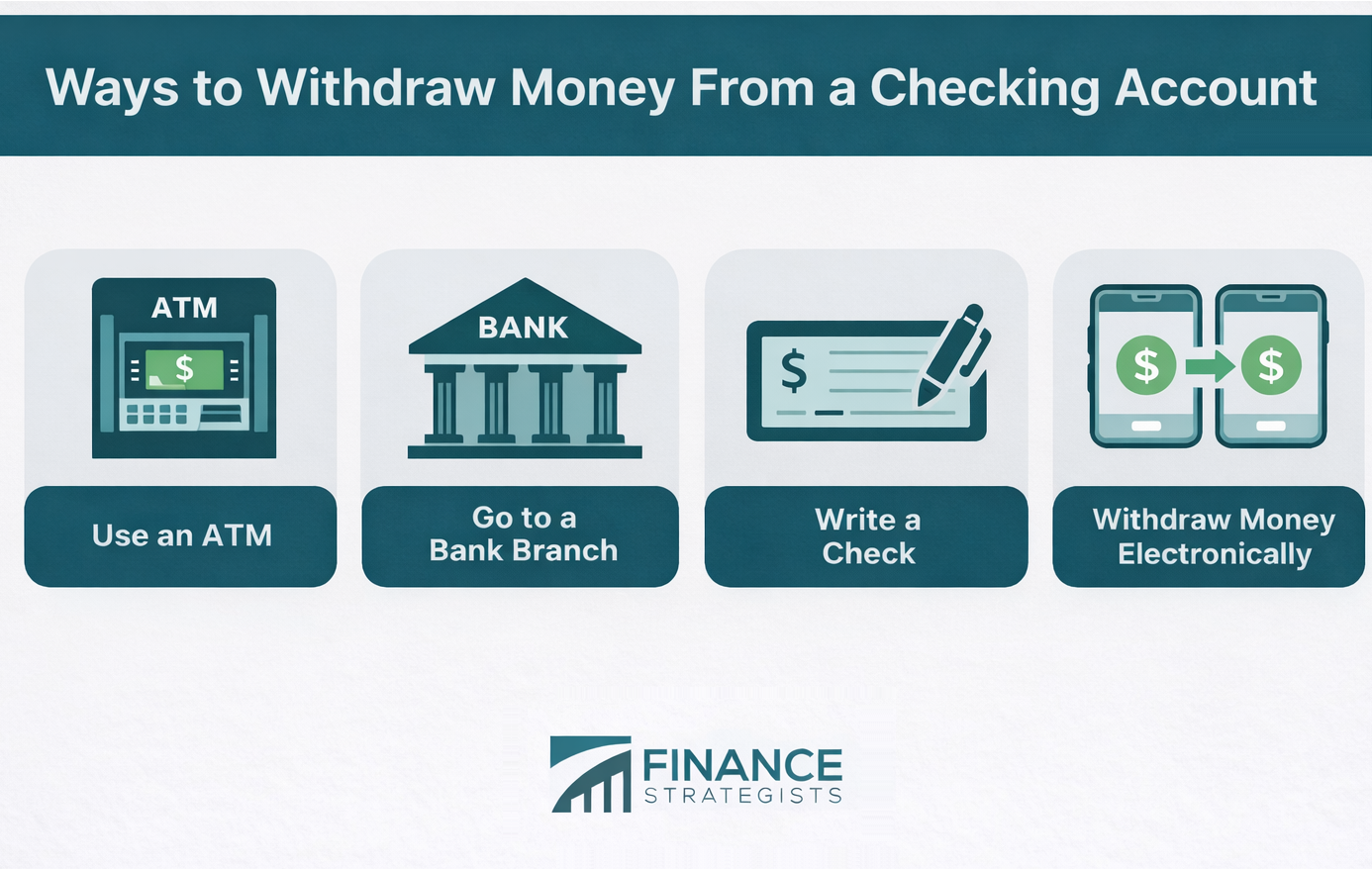
A checking account is designed for everyday financial transactions. It allows you to deposit money, make payments, transfer funds, and withdraw cash easily and frequently. Unlike savings accounts, which are typically intended for storing money and earning interest over time, checking accounts prioritize accessibility and convenience. This makes them the primary account most people use to manage daily expenses such as groceries, rent, utilities, and subscriptions. Most people withdraw money using one of four primary methods: an ATM, a bank teller, a check, or an electronic transfer. Each option offers different advantages depending on how quickly you need the money, how much you want to withdraw, and whether you prefer cash or digital access. Many employers also use checking accounts for direct deposit, enabling wages to be sent electronically and made available quickly. Because of these features, checking accounts function as the central hub of most personal financial activity. While checking accounts are highly flexible, they may also include certain rules or costs. Some banks charge monthly maintenance fees unless minimum balance or activity requirements are met. Others may impose overdraft fees if you spend more than your available balance, though many institutions now offer overdraft protection options or alerts to help prevent this. Interest earnings on checking accounts are typically low or nonexistent, since the account’s primary purpose is transaction efficiency rather than long-term growth. ATMs are widely available and allow account holders to access funds at any time, often without needing to visit a bank branch. To withdraw cash, you typically insert or tap your debit card, enter your PIN, select the withdrawal option, choose your checking account if prompted, enter the desired amount, and collect your cash and receipt. Many ATMs also offer preset withdrawal amounts, which can make the process even quicker. After authentication with your PIN, the machine verifies your available balance and dispenses the requested cash immediately. Once the transaction is complete, the withdrawal amount is usually reflected in your account balance right away. Banks generally impose daily ATM withdrawal limits to reduce the risk of fraud and unauthorized access. These limits often range from a few hundred dollars to around one thousand dollars per day, though they vary depending on the bank, account type, and customer history. If you need more cash than your limit allows, you may be able to request a temporary increase or complete the withdrawal at a bank branch instead. ATM withdrawals may involve fees depending on where you use the machine. Withdrawals from your bank’s own ATM network are commonly free, while using an out-of-network ATM may result in a charge from both the ATM operator and your bank. International ATM withdrawals can be more expensive because they may include currency conversion charges and additional service fees. Checking your bank’s ATM network beforehand can help you avoid unnecessary costs. Visiting a bank branch allows you to withdraw money directly from a teller, which is often the best option for large withdrawals or situations where you need assistance. When withdrawing at a branch, you may be asked to complete a withdrawal slip or present your debit card, along with a valid photo ID. After confirming your account and balance, the teller will provide the requested cash or issue a cashier’s check if you prefer certified funds. A teller withdrawal is often preferable when you need more cash than an ATM allows, do not have your debit card available, or require official bank instruments such as cashier’s checks. Branch withdrawals also provide the opportunity to ask questions, confirm balances, or request guidance on safer ways to move large sums of money. Checks provide another flexible way to withdraw funds from a checking account. Writing a check to yourself allows you to access money by cashing or depositing the check at a bank. When completing such a check, you simply write your own name as the payee, sign it, and endorse the back when presenting it for payment. This effectively converts your account balance into cash or transfers it to another account. Using a self-written check can be helpful if you want to withdraw funds without using an ATM or debit card. After endorsing the check, you can cash it at your bank or deposit it elsewhere, depending on your needs. You may also write a check to another person or organization. Then the funds are withdrawn from your account once the check is deposited or cashed. This method is commonly used for payments that require documentation or a physical record. Checks create a traceable paper trail and can be useful for large or formal transactions. However, they generally take longer to process than electronic withdrawals and may not be accepted everywhere. Because checks can be lost or stolen, they should be handled carefully to reduce fraud risk. This method has become increasingly common due to the convenience of online and mobile banking. Online transfers allow you to move funds from your checking account to another account, either within the same bank or at a different financial institution. These transfers typically occur through the Automated Clearing House network and often take one to three business days to complete, although some banks offer faster or instant options. Mobile banking apps have expanded withdrawal options significantly. Some banks allow cardless ATM withdrawals initiated through the app, while others support transfers to digital payment services or instant movement between linked accounts. These features can provide fast access to funds even when your debit card is unavailable. You may also use wire transfers. They are one of the fastest electronic withdrawal methods, often delivering funds on the same day. They are frequently used for high-value or time-sensitive transactions, such as real estate closings or urgent payments. However, they usually involve higher fees than standard transfers, making them most appropriate when speed is essential. Using an ATM within your bank’s network is typically free, since banks encourage customers to use their own machines or partner networks. However, withdrawing from an out-of-network ATM may result in two separate fees: one from the ATM operator and another from your bank. These combined charges often range from a few dollars to several dollars per transaction. Frequent use of out-of-network ATMs can add up quickly, making it worthwhile to locate nearby in-network machines whenever possible. When withdrawing cash outside your home country, additional costs may apply. Banks and ATM operators may charge international transaction fees, foreign ATM access fees, and currency conversion charges. The exchange rate applied to the withdrawal may also include a markup, which increases the overall cost. Because of these extra expenses, travelers often benefit from choosing banks that offer reduced international ATM fees or reimbursed foreign ATM charges. Wire transfers are one of the fastest ways to withdraw or move money electronically, but they are also among the most expensive. Domestic wire transfers commonly involve a flat fee, while international wires typically cost more due to added processing requirements and intermediary bank charges. Because of these costs, wire transfers are generally best reserved for urgent or high-value transactions where speed is essential. If a withdrawal exceeds your available balance, your bank may approve the transaction and cover the shortfall temporarily, resulting in an overdraft. This often triggers an overdraft fee, which can be substantial depending on the bank’s policies. If the bank declines the withdrawal instead, you may still face an insufficient funds fee. Monitoring your balance carefully and setting up account alerts or overdraft protection can help you avoid these charges. Although not directly tied to a single withdrawal, some checking accounts charge monthly maintenance or service fees that effectively increase the cost of accessing your money. These fees are sometimes waived if you maintain a minimum balance, set up direct deposit, or meet other activity requirements. Choosing an account structure that matches your usage patterns can reduce or eliminate these recurring expenses. Your personal identification number and banking login credentials are the keys to your account and should always be kept confidential. Avoid writing your PIN on your debit card or storing it in easily accessible places. When entering your PIN at an ATM or point-of-sale terminal, shield the keypad with your hand to prevent others from seeing it. Similarly, use strong, unique passwords for online banking and enable multi-factor authentication whenever available to add an extra layer of protection. Choosing the right ATM location can significantly improve your safety. Machines located inside bank branches, shopping centers, or well-lit public areas tend to be safer than isolated outdoor ATMs. Before using a machine, check for signs of tampering, such as loose card slots or unusual attachments that could indicate a skimming device. If anything looks suspicious, cancel the transaction and find another ATM. If you need to withdraw a large amount of cash, it is often safer to notify your bank in advance. This allows the bank to prepare the funds and may help prevent your transaction from being flagged as suspicious activity. When carrying large sums of cash, avoid counting it in public and consider going directly to your destination afterward rather than making additional stops. Keeping withdrawal receipts until you confirm the transaction on your bank statement can help you quickly identify errors or unauthorized activity. Regularly reviewing your account through online or mobile banking makes it easier to spot unfamiliar withdrawals, duplicate transactions, or fraudulent charges. Many banks also offer real-time alerts that notify you whenever money leaves your account, providing an additional safeguard. When transferring funds or managing withdrawals electronically, avoid using unsecured public Wi-Fi networks. These networks can expose your login information to hackers or malicious software. Instead, use a secure home network or your mobile data connection when accessing your banking app or website. Logging out after each session and keeping your banking app updated can further improve digital security. Withdrawing money from a checking account can be done quickly and safely through several methods, including ATMs, bank tellers, checks, and electronic transfers. Each option serves a different purpose, whether you need immediate cash, secure movement of large sums, or convenient digital payments. By understanding withdrawal limits, potential fees, and basic security practices, you can access your funds efficiently while protecting your financial information.Overview of Checking Accounts
Ways to Withdraw Money From a Checking Account
Method 1: Use an ATM
Method 2: Go to a Bank Branch
Method 3: Write a Check
Method 4: Withdraw Money Electronically
Fees Associated With Checking Account Withdrawals
ATM Network and Out-of-Network Fees
International Withdrawal and Currency Conversion Fees
Wire Transfer Fees
Overdraft and Insufficient Funds Fees
Account Maintenance and Service Fees
Best Practices for Withdrawing Money From a Checking Account
Protect Your PIN and Account Credentials
Use Secure and Well-Lit ATMs
Plan Ahead for Large Withdrawals
Monitor Receipts and Account Activity
Avoid Public Wi-Fi for Online Transactions
The Bottom Line
How to Withdraw From a Checking Account FAQs
You can generally withdraw any amount up to your available balance, though ATM transactions are limited by daily caps. Larger withdrawals may require a branch visit.
Banks typically allow substantial teller withdrawals, but extremely large amounts may require advance notice to ensure cash availability and security.
Most ATMs allow withdrawals, but using one outside your bank’s network may result in additional fees.
ATM withdrawals and debit transactions usually update your available balance right away. Checks and certain transfers may take additional time to fully clear.
Another person can withdraw funds only if they have proper authorization, such as joint ownership, legal authority, or a signed check permitting access.
True Tamplin is a published author, public speaker, CEO of UpDigital, and founder of Finance Strategists.
True is a Certified Educator in Personal Finance (CEPF®), author of The Handy Financial Ratios Guide, a member of the Society for Advancing Business Editing and Writing, contributes to his financial education site, Finance Strategists, and has spoken to various financial communities such as the CFA Institute, as well as university students like his Alma mater, Biola University, where he received a bachelor of science in business and data analytics.
To learn more about True, visit his personal website or view his author profiles on Amazon, Nasdaq and Forbes.