
Lenders can generally check your bank information, but they need your permission. What they see depends on the method used: you can provide bank statements, link an account, or allow them to confirm balances via request. The goal is usually to validate assets, confirm income deposits, and ensure you can cover down payment, closing costs, and required reserves. There are some scenarios in which lenders can obtain limited information through legal channels, such as a court order or certain government collection contexts, but these are not the typical mortgage, auto loan, or personal loan experience most borrowers have. For everyday lending, the lender’s ability to view your bank information is tied to what you supply and what you approve. Banks and privacy laws are designed to protect account information, and lenders must comply with regulations and document the reasons and methods used to access information. If a lender wants to see more than what you originally provided, you’ll usually be asked again, either for updated documents or renewed authorization. Lenders are assessing whether you’re likely to qualify and at what price point. For mortgages, this often includes confirming that you have sufficient funds for a down payment, closing costs, and, in some cases, reserves. For other loan types, the focus may be more about cash flow and existing obligations. At this stage, lenders may request recent bank statements, typically covering a period of one to two months. The intent is not to judge every purchase, but to confirm you are not overstating your financial position. A borrower who claims significant savings but cannot document them raises an immediate red flag. Underwriting is where lenders verify that the story told by your application is accurate. Bank records can support or contradict income claims, reveal undisclosed debts, or raise questions about financial stability. Underwriters are trained to identify patterns that indicate risk, such as recurring overdrafts, unstable balances, or deposits that appear to be borrowed funds. This is also where bank information helps confirm that your down payment and closing funds are sourced properly. Lenders care about the source of funds because many loan programs require that funds not be borrowed in a way that increases your debt burden, unless those loans are properly disclosed and allowed. Bank statements can show whether a down payment suddenly appeared from a personal loan, a cash advance, or another prohibited source. Many borrowers assume that once they’re approved, the lender is done with their review, but many lenders perform final verifications shortly before funding or closing. This is partly risk management and partly compliance. The lender wants to confirm that major changes did not occur after approval, such as a large withdrawal that drains your closing funds. Even if your credit report is strong, a lender still needs assurance that you can actually bring money to the table and maintain required reserves if the loan program requires them. Not every borrower file fits neatly into a checklist. If your income varies, you’re self-employed, you have multiple accounts, or your down payment involves gifts and transfers, the lender may request additional documentation and take a closer look. In this context, “closer” does not necessarily mean invasive. It just means the underwriter needs to resolve a specific question: Where did this deposit come from? Why did balances drop sharply? Is this recurring payment a debt that should be counted? If your profile is borderline—perhaps your debt-to-income ratio is near the maximum, your credit score is on the edge of a pricing tier, or your cash reserves are thin—bank activity becomes more important. The lender is looking for signals that you can handle the payment even if something changes. This is familiar, document-based underwriting. The lender requests statements; you upload them, and the underwriter reviews them. When lenders request statements, they typically specify the time window and which accounts matter. Many mortgage lenders ask for the most recent one to two months of statements for checking and savings accounts used for closing. If you’re using investment accounts or money market accounts as a source of funds, those may be requested as well. The key is that the lender needs to see accounts tied to the funds you plan to use, not necessarily every account you’ve ever had. Statements are used because they are a standardized record from a financial institution. Underwriters rely on them to verify assets, confirm that balances are sufficient, and identify large or irregular deposits that require documentation. Statements also help confirm that funds have been in your account long enough to satisfy certain program rules, or that they are properly sourced if they arrived recently. Statements serve two purposes at once. They confirm capacity—do you have enough money—and they support credibility—does your financial behavior align with what you reported. If you stated a certain income and the deposits align with that narrative, the file becomes easier to approve. Digital bank verification is increasingly common because it reduces paperwork and accelerates underwriting. When a lender asks you to link your bank, they are typically using a third-party platform that connects to your bank through a secure portal. You log in to your bank through that portal, consent to share information, and the platform delivers a verification report to the lender. Linking your bank account usually means you consent to share certain data fields for a defined purpose and time period. The scope can vary by lender and platform. Sometimes the report focuses on balances and recent deposits. Other times, it includes transaction-level data, such as recurring income deposits and certain recurring payments. The idea is permanent surveillance, but to produce a snapshot report that satisfies underwriting requirements. Still, you should treat digital verification like any other authorization: understand what you are agreeing to. Many platforms show a consent screen that describes what will be accessed and for how long. Some authorizations can be revoked later, while others are designed for a one-time pull. If you are uncomfortable, you can decline and provide statements instead; however, the lender may require an alternative form of verification, which may lengthen the process. A verification of deposit request (VOD) is a process in which the lender asks the bank to verify account information. This often confirms ownership of the account and the balance as of a certain date. It may also confirm average balances over a period, depending on what the bank provides and what the lender requests. The key feature of a VOD-style confirmation is that it does not show where you bought groceries, what subscriptions you pay for, or every transfer you made. Instead, it confirms that the account exists, belongs to you, and contains the claimed funds. This method can be helpful when the lender wants confirmation directly from the institution, especially if statements are incomplete, there are concerns about altered documents, or the loan program requires independent verification. Balances matter because they are tied to your ability to close and your financial cushion afterward. A borrower who can close but will be left with almost nothing in reserve may be riskier than a borrower with the same income who maintains stable savings. For certain loans, required reserves are not optional; they are part of the qualification criteria. If you report a steady W-2 job, underwriters expect regular payroll deposits that align with pay stubs and employment verification. If deposits are inconsistent or lower than reported, the lender may request clarification. For borrowers with irregular income—contractors, gig workers, seasonal employees, and self-employed individuals—the lender may not rely solely on deposits. They can also flag potential issues, such as reliance on a single unstable client or sudden income declines. If you provide statements, the lender can see line-item transactions on those statements. If you use digital verification, the report may include categorized transaction data, but not always. Some verification tools provide a summary of recurring income and expenses, while others provide more detailed transaction lists. Lenders generally do not have real-time, open-ended monitoring of your bank account without renewed consent. They are not continuously monitoring your spending after you apply, and they cannot access your accounts at will. Access is typically limited to the time window you provide or authorize. If the lender wants updated information, they usually have to ask again. Lenders also do not automatically see your full financial life outside what you provide or authorize. If you have accounts at other institutions that you do not disclose and that are not required for the application, the lender will not magically see them through standard bank verification processes. The underwriting process relies on documentation and disclosure, and while lenders can cross-check certain information through credit reports and verification systems, bank accounts are not universally visible without your involvement. In the month or two before applying, you want your bank activity to look predictable and responsible, not chaotic. Maintaining a buffer to avoid overdrafts is one of the simplest and most powerful steps. Even a modest cushion can prevent the kind of negative bank markers that underwriters dislike. You also want to avoid making sudden, large purchases or transfers that could raise questions. If you need to make a major purchase, consider timing it after closing when possible. If you need to move money, keep it traceable and documentable. If you anticipate questions, prepare documentation early. Gift funds should be documented with a gift letter and proof of transfer, and lenders may require evidence that the donor had the ability to make the gift. Reimbursements should be supported by receipts and proof of legitimacy. Proceeds from sales should be documented with bills of sale, closing statements, or transaction records. Transfers between accounts are not inherently problematic, but they should be easy to follow. If you move funds from savings to checking for closing, retain statements for both accounts and verify that the transfer amounts match. Underwriters love clean paper trails because they reduce risk and compliance issues. When you provide clarity, you reduce delays. If the lender offers or requests a digital bank link, use the lender’s secure portal and avoid sharing credentials through email or text. Legitimate verification platforms are designed to protect your login information, and reputable lenders will route you through a secure process. Before you consent, understand what you are sharing. Many platforms allow you to view the scope of data access, including balances, transaction history, and the covered time period. If you have concerns, ask whether you can provide statements instead. Lenders usually verify bank information through permission-based access. They can review what you provide and what you authorize, and they typically do so at the application stage, during underwriting, and sometimes again right before closing. They are not silently monitoring your account in real time without renewed consent, and they do not automatically see your entire financial life beyond what you disclose and approve. The best way to prepare is to keep your finances stable in the 30 to 60 days before applying, avoid overdrafts, and minimize sudden large moves unless you can document them cleanly. If you anticipate questions—gift funds, irregular deposits, transfers, side income—prepare the paper trail early. When your bank documentation tells a clear, consistent story, underwriting becomes faster, smoother, and far less stressful.Can a Lender Check Your Bank Account?
When a Lender Might Look at Your Bank Information
During The Application Or Pre-Approval Stage
During Underwriting
Right Before Funding Or Closing
When Your File Is Borderline Or Needs Clarification
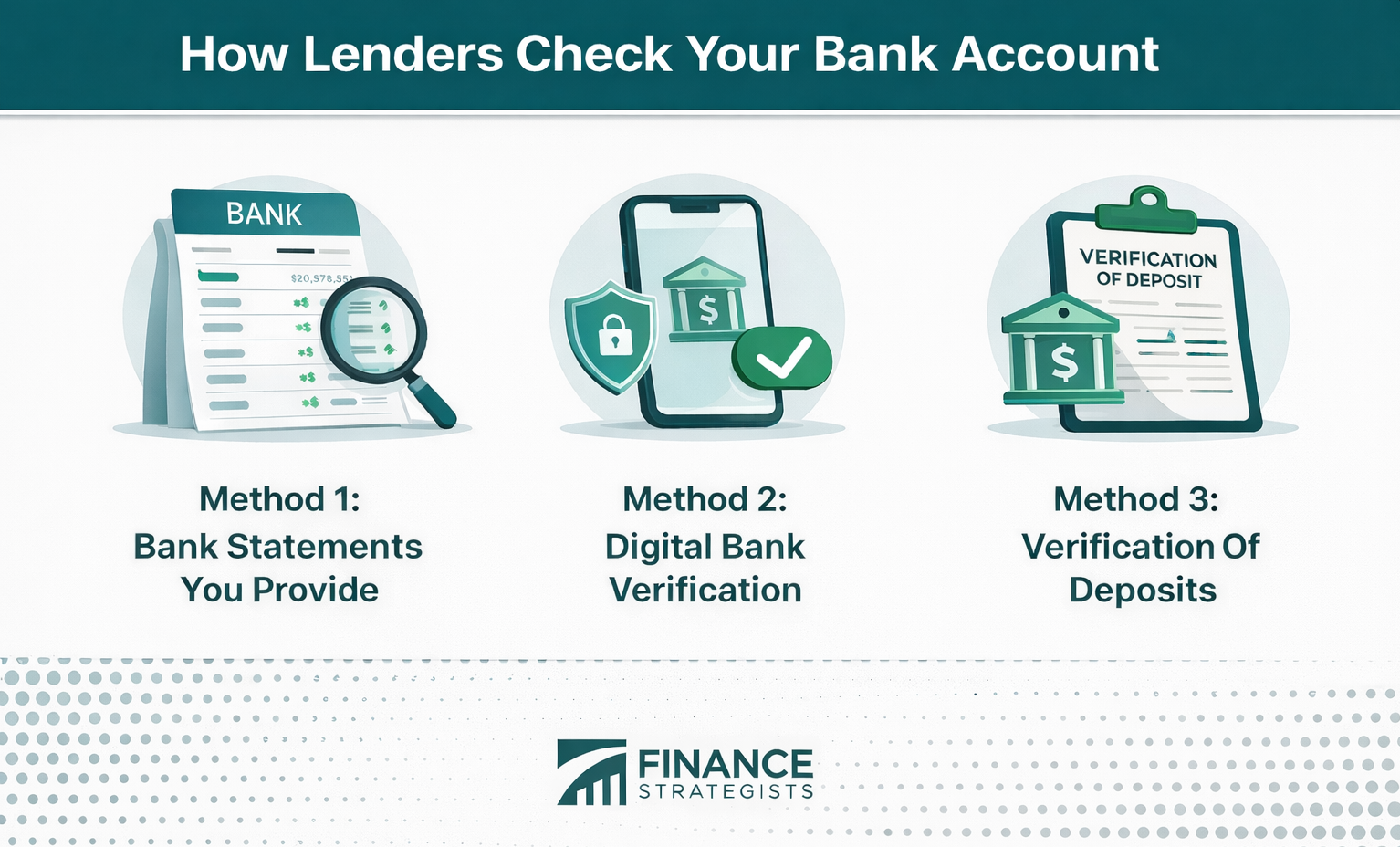
How Lenders Check Your Bank Account
Method 1: Bank Statements You Provide
Method 2: Digital Bank Verification
Method 3: Verification Of Deposits
What Can Lenders Check?
Balances And Average Balances
Deposit Patterns
Transactions And Categories
What Lenders Generally Don’t See Automatically
Best Practices For When Lenders Check Your Accounts
Show Stability
Have Documentation
Protect Yourself
Final Thoughts
Can a Lender Check Your Bank Account? FAQs
In typical lending scenarios, lenders do not access your bank account without your knowledge because they need your permission or your documents. If a lender reviews your bank information, it usually happens because you provided statements, signed an authorization, or linked an account through a verification tool.
It depends on the method. Bank statements show transactions, deposits, and balances over the statement period. A verification of deposit usually confirms ownership and balances, sometimes average balances, without full transaction detail. Digital verification can vary: some reports summarize balances and income deposits, while others include transaction-level data and categories. You can often see what is being shared during the consent process.
In many cases, yes. If you do not want to link your bank account digitally, you can often provide bank statements instead. Some lenders prefer digital verification for speed, but most still accept traditional documentation. The tradeoff is usually convenience versus paperwork, not approval versus denial.
Linking your bank account through a reputable lender’s secure verification portal is generally designed to be safe, but “safe” depends on execution. You should only link through the official lender portal, confirm you are on a secure connection, and avoid sharing credentials through unsecured channels. Review the consent terms so you understand what data is being accessed and for how long. If you are uncomfortable, request document-based verification.
Standard lenders do not. Once the loan is funded, they only care that you make your monthly payments. However, if you default on a loan and the lender wins a court judgment against you, they may gain the legal right to garnish or levy your account.
True Tamplin is a published author, public speaker, CEO of UpDigital, and founder of Finance Strategists.
True is a Certified Educator in Personal Finance (CEPF®), author of The Handy Financial Ratios Guide, a member of the Society for Advancing Business Editing and Writing, contributes to his financial education site, Finance Strategists, and has spoken to various financial communities such as the CFA Institute, as well as university students like his Alma mater, Biola University, where he received a bachelor of science in business and data analytics.
To learn more about True, visit his personal website or view his author profiles on Amazon, Nasdaq and Forbes.