

Gold investing refers to the practice of purchasing assets linked to the value of gold with the goal of preserving wealth, diversifying a portfolio, or protecting against economic uncertainty. Unlike stocks or bonds, gold is a physical commodity whose value is primarily driven by global supply and demand rather than the performance of a company or the creditworthiness of an issuer. Investors can gain exposure to gold either by purchasing the metal itself or by investing in financial instruments designed to track its market price. Many investors are drawn to gold because of its historical reputation as a store of value. During periods of inflation, currency depreciation, or financial instability, gold has often been viewed as a way to preserve purchasing power. For this reason, investors frequently consider gold when they are seeking protection from market volatility or when they want to diversify beyond traditional financial assets. Because gold prices often move differently than stocks and bonds, even a modest allocation can sometimes help reduce overall portfolio risk. Gold has also played a significant role in the history of global finance. For thousands of years, civilizations used gold as a medium of exchange and a foundation for monetary systems. In the modern era, many countries once tied their currencies directly to gold through the gold standard, a system that linked paper money to a fixed quantity of the metal. Although most economies abandoned the gold standard during the 20th century, gold continues to hold economic significance today. Central banks still maintain substantial gold reserves, and investors around the world continue to view the metal as a symbol of financial stability during uncertain times. Physical gold includes tangible forms of the metal such as bullion bars, coins, and jewelry. Investors who prefer physical gold often value its status as a real, tangible asset that exists outside the financial system. In times of severe financial disruption, physical gold can retain value when other assets falter. However, owning physical gold comes with practical challenges. Investors must store it securely, insure it against theft, and sometimes pay premiums when buying or selling. For many investors, these logistical considerations make physical gold less convenient than financial alternatives. Gold exchange-traded funds are among the most popular ways to invest in gold. These funds track the price of gold and trade on stock exchanges just like individual stocks. Gold ETFs allow investors to gain exposure to gold without the complications of storage and security. They also provide high liquidity, meaning shares can be bought and sold quickly during market hours. The main drawback is that investors do not physically own gold when they purchase ETF shares. Instead, they own a financial instrument designed to mirror gold’s price movements. Another way to invest in gold is to purchase shares in companies that mine and produce it. Gold mining stocks can sometimes deliver higher returns than gold itself because mining companies may benefit from rising gold prices while also expanding production and improving operational efficiency. However, these stocks introduce additional risks. Company management decisions, operational costs, and geopolitical factors affecting mining operations can all influence performance. As a result, mining stocks behave partly like commodities and partly like traditional equities. Gold mutual funds invest in diversified portfolios of gold-related assets, often including multiple mining companies or gold-linked securities. These funds allow investors to spread risk across several companies within the gold industry rather than relying on a single mining firm. However, like most actively managed mutual funds, they typically charge management fees that can slightly reduce overall returns. One of the most commonly cited reasons for owning gold is its ability to protect purchasing power over time. During periods of high inflation, the value of paper currency tends to decline as prices rise across the economy. Because gold is a finite resource with intrinsic value, its price often increases when inflation accelerates. While the relationship between gold and inflation is not perfect in the short term, gold has historically helped preserve wealth over long time horizons. Gold often behaves differently from traditional financial assets such as stocks and bonds. When equity markets experience turbulence, gold prices sometimes move in the opposite direction. This low correlation can help reduce overall portfolio volatility. Adding a small allocation of gold may therefore improve a portfolio’s risk-adjusted returns by balancing out fluctuations in other asset classes. Gold frequently attracts investors during times of global uncertainty. Financial crises, geopolitical conflicts, currency instability, and economic recessions can all drive increased demand for gold. During these periods, investors often turn to gold as a perceived safe haven. This tendency can cause gold prices to rise when other investments decline. Unlike stocks, bonds, or digital assets, gold is a physical commodity with inherent value. It cannot be created by central banks or corporations. For investors concerned about financial system instability, gold’s tangible nature provides a sense of security that purely financial assets may lack. Gold does not produce income. Stocks may pay dividends. Bonds generate interest payments. Real estate can produce rental income. Gold, by contrast, simply sits in storage or in an investment account while its value fluctuates. This lack of cash flow means gold relies entirely on price appreciation for returns. Although gold is often viewed as stable, its price can fluctuate significantly over shorter time periods. Gold prices are influenced by multiple economic factors, including interest rate changes, currency strength, central bank policy, investor sentiment, and even geopolitics. These forces can cause gold prices to rise or fall rapidly, sometimes surprising investors who expect stability. Physical gold requires secure storage, which may involve renting a safety deposit box or using specialized vaulting services. Insurance may also be necessary to protect against theft or damage. These additional costs can reduce the net returns of physical gold investments. Historically, equities have delivered significantly higher long-term returns than gold. Investors who allocate too much capital to gold may miss out on the growth potential of productive assets such as businesses and real estate. For this reason, many financial advisors recommend limiting gold exposure within diversified portfolios. Gold tends to perform best under specific economic conditions. Periods of high inflation often support rising gold prices, particularly when inflation outpaces interest rates. When real interest rates fall, gold becomes more attractive relative to interest-bearing assets. Gold may also benefit from geopolitical instability or financial crises, as investors seek assets perceived as safe stores of value. Currency weakness can further strengthen gold demand. When a country’s currency depreciates, gold priced in that currency may become more valuable. However, gold does not always perform well during these conditions. Market dynamics are complex, and gold’s behavior can vary depending on broader economic forces. Determining how much gold to include in a portfolio depends on an investor’s financial goals, risk tolerance, and overall asset allocation strategy. In most cases, financial professionals view gold as a supplemental asset rather than a primary driver of long-term growth. Because gold does not generate income and its long-term returns have historically lagged behind equities, it is typically used in moderation as a diversification tool rather than as a core investment. Many portfolio allocation models suggest that a relatively small exposure to gold can provide diversification benefits without significantly reducing growth potential. For general diversification purposes, investors often allocate roughly 0% to 5% of a portfolio to gold. Investors who are particularly concerned about inflation, currency instability, or economic uncertainty may increase that exposure slightly, often allocating 5% to 10% as a hedge against macroeconomic risks. In more defensive strategies designed specifically to guard against severe economic instability, allocations may sometimes rise to 10% to 15%, though such levels are less common for typical long-term investors. The appropriate allocation ultimately depends on the investor’s objectives and the role gold is intended to play within the broader portfolio. Investors focused primarily on long-term growth may prefer minimal exposure, while those seeking additional protection against inflation or financial instability may allocate somewhat more. In most diversified portfolios, however, gold is used as a complementary asset—one component of a broader investment strategy designed to balance growth potential with resilience during periods of economic uncertainty. Treasury Inflation-Protected Securities are government bonds specifically designed to protect investors from inflation. The principal value of TIPS adjusts with changes in the Consumer Price Index (CPI), meaning that as inflation rises, the value of the bond increases. Because they are backed by the U.S. government and provide interest payments, TIPS can offer inflation protection while also generating income. For investors primarily concerned about preserving purchasing power, TIPS may provide a more predictable inflation hedge than gold. Real estate has historically served as another effective hedge against inflation. Property values and rental income often rise alongside increases in the cost of living, which can help protect investors from declining purchasing power. Unlike gold, real estate can also produce ongoing cash flow through rent payments. However, real estate investments can require significant capital, may involve property management responsibilities, and are generally less liquid than financial securities. Commodity funds provide exposure to a broad range of raw materials such as energy resources, agricultural products, and industrial metals. Because commodity prices often rise during inflationary periods, these funds can offer similar diversification and inflation protection benefits to gold while spreading risk across multiple commodities. This broader exposure may reduce the concentration risk associated with investing in a single commodity like gold. Diversified commodity exchange-traded funds combine exposure to multiple commodities within a single investment vehicle. These ETFs often track indexes composed of various commodities, allowing investors to gain access to a wide range of resources without having to purchase each individually. By diversifying across several commodities, these funds may provide inflation protection and portfolio diversification while reducing the volatility that can accompany investments in a single commodity such as gold. Certain investors view cryptocurrencies as a modern alternative to gold. For example, bitcoin is sometimes described as “digital gold” because of its fixed supply and decentralized structure. However, cryptocurrencies are significantly more volatile than gold and have a much shorter historical track record. While some investors include small cryptocurrency allocations as a hedge against currency debasement, the asset class carries substantial risk and remains highly speculative. Some investors allocate small portions of their portfolios to tangible assets such as fine art, rare coins, vintage automobiles, or collectibles. These assets can sometimes maintain value during inflationary periods because their supply is limited. However, collectibles are typically illiquid, difficult to value, and subject to changing tastes, making them far less predictable than traditional financial investments. Gold occupies a unique place in the investment world. It is neither a traditional growth asset nor a purely defensive one. Instead, it functions as a potential stabilizer within a broader portfolio. For investors concerned about inflation, market volatility, or currency risk, gold can provide a measure of protection and diversification. However, its lack of income generation and historically lower long-term returns mean it should rarely dominate an investment strategy. Used thoughtfully and in moderation, gold can serve as a valuable complement to stocks, bonds, and other assets—helping investors build portfolios that balance growth with resilience.What Is Gold Investing?
Types of Gold Investments
Physical Gold
Gold ETFs
Gold Mining Stocks
Gold Mutual Funds
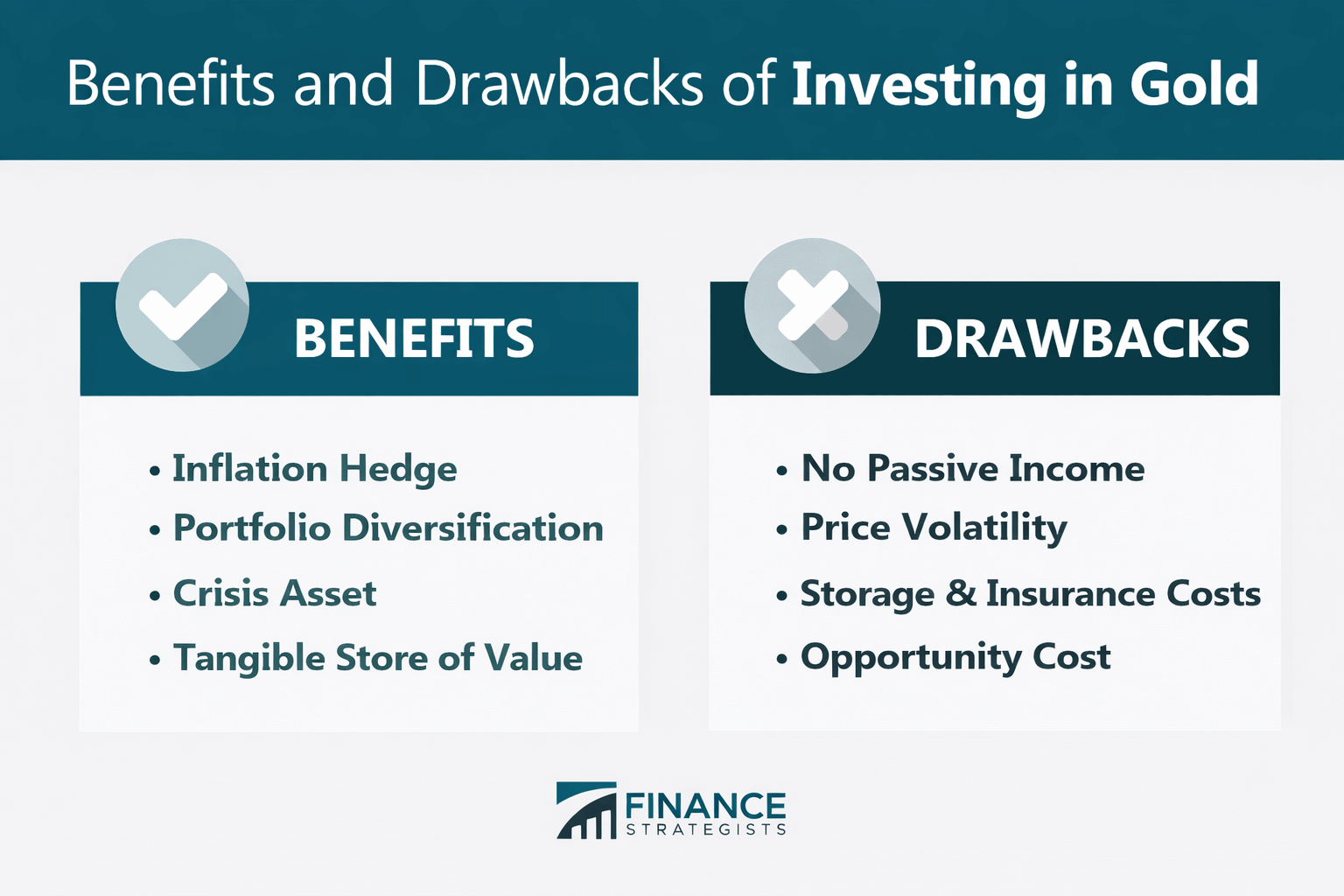
Benefits of Investing in Gold
Inflation Hedge
Portfolio Diversification
Crisis Asset
Tangible Store of Value
Drawbacks of Investing in Gold
No Passive Income
Price Volatility
Storage and Insurance Costs
Opportunity Cost
When Might Gold Perform Well?
How Much Gold Should Be in Your Portfolio?
Alternatives to Gold
Treasury Inflation-Protected Securities (TIPS)
Real Estate
Commodity Funds
Diversified Commodity ETFs
Cryptocurrency
Collectibles and Hard Assets
Final Thoughts
Should You Invest in Gold? FAQs
Whether gold is a good investment right now depends on economic conditions and your goals. Gold often attracts interest during periods of inflation, geopolitical uncertainty, or market volatility, but it should generally be viewed as a diversification tool rather than a primary growth investment.
Gold has historically helped preserve purchasing power over long periods, which is why it is often considered an inflation hedge. However, the relationship between gold and inflation is not always consistent in the short term.
Many investors consider gold exchange-traded funds (ETFs) one of the safest and most convenient ways to invest in gold because they provide exposure to gold prices without the need to store or insure physical metal.
Financial professionals typically recommend keeping gold allocations relatively small, often between 0% and 10% of a portfolio. But the appropriate percentage depends on your risk tolerance, financial goals, and concerns about inflation or market volatility.
Investors seeking similar benefits to gold may consider alternatives such as Treasury Inflation-Protected Securities (TIPS), real estate, diversified commodity funds, or broad stock market investments. These assets can offer inflation protection or diversification while potentially generating income or long-term growth.
True Tamplin is a published author, public speaker, CEO of UpDigital, and founder of Finance Strategists.
True is a Certified Educator in Personal Finance (CEPF®), author of The Handy Financial Ratios Guide, a member of the Society for Advancing Business Editing and Writing, contributes to his financial education site, Finance Strategists, and has spoken to various financial communities such as the CFA Institute, as well as university students like his Alma mater, Biola University, where he received a bachelor of science in business and data analytics.
To learn more about True, visit his personal website or view his author profiles on Amazon, Nasdaq and Forbes.