
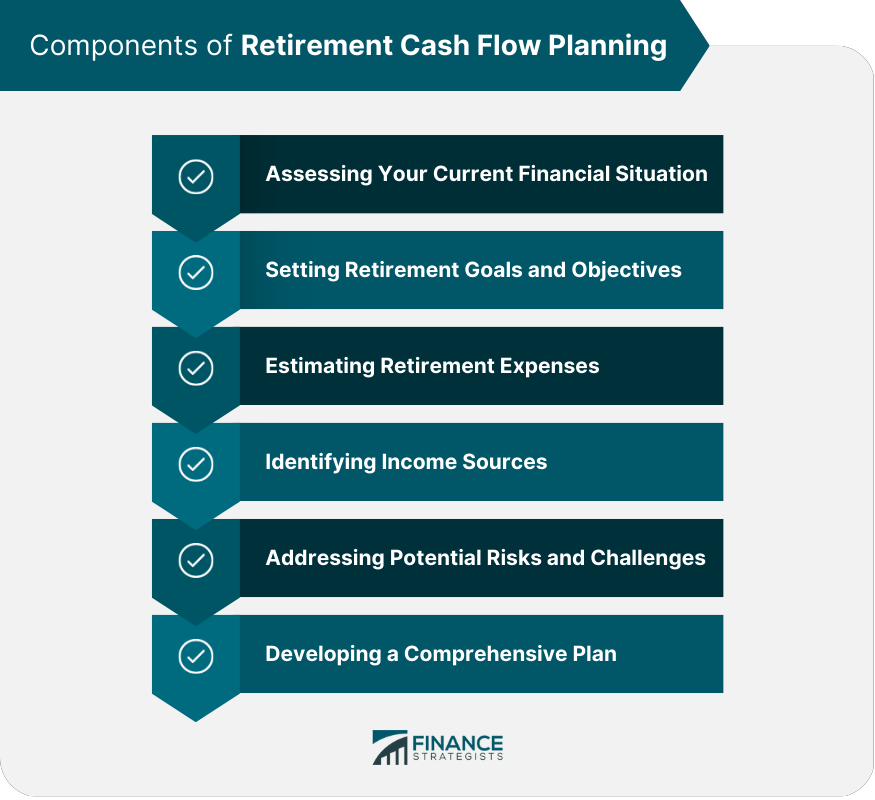
Retirement cash flow planning is the process of analyzing your current financial situation, setting retirement goals, and devising strategies to ensure a consistent and reliable income during your retirement years. This planning involves estimating the sources of retirement income, such as Social Security benefits, pensions, investment income, and retirement savings, and comparing them with anticipated expenses, including housing, healthcare, travel, and daily living expenses. The goal is to create a sustainable financial plan that allows retirees to enjoy their retirement years without the fear of running out of money. Retirement cash flow planning is a complex process that involves multiple components. Each component plays a crucial role in helping you achieve financial security during your retirement years. Here, we will elaborate on the key components of retirement cash flow planning. Understanding your current financial situation is the foundation for effective retirement cash flow planning. This includes evaluating your assets, such as savings, investments, real estate, and other valuable possessions, as well as your liabilities, such as mortgage, loans, and credit card debt. Additionally, you should consider your current income and expenses to determine your financial capacity to save for retirement and make necessary adjustments to your lifestyle if needed. Defining your retirement goals and objectives helps you determine the lifestyle you want to maintain during retirement. Consider factors such as when you want to retire, the type of residence you would like to live in, whether you plan to travel or pursue hobbies, and any financial support you may need to provide for family members. By establishing clear goals, you can create a roadmap for achieving the retirement lifestyle you envision. A crucial part of retirement cash flow planning is estimating the expenses you will incur during your retirement years. These expenses can include housing (mortgage or rent payments, taxes, maintenance, and utilities), healthcare (insurance premiums, out-of-pocket costs, and long-term care), daily living expenses (groceries, transportation, insurance), and discretionary expenses (travel, hobbies, entertainment). Accurate estimation of retirement expenses helps you determine the amount of income you will need to maintain your desired lifestyle. Once you have a clear understanding of your retirement expenses, it is essential to identify potential income sources to cover those expenses. Common income sources during retirement include: Social Security benefits Pensions Part-time or freelance work Rental income By diversifying your income sources, you can reduce the risk of financial hardship if one source becomes unreliable. Retirement cash flow planning also involves identifying and addressing potential risks and challenges that could impact your financial security. Some common risks and challenges include market volatility, inflation, increasing healthcare costs, changes in tax laws, and unexpected life events (such as the death of a spouse or a serious illness). Developing strategies to mitigate these risks can help you maintain your financial stability during retirement. The final component of retirement cash flow planning is developing a comprehensive plan that outlines the steps you will take to achieve your retirement goals and maintain financial security. This plan should detail your savings and investment strategies, asset allocation, Social Security claiming strategy, retirement account withdrawal strategies, long-term care planning, and any other relevant aspects of your financial life. By having a well-thought-out plan in place, you can ensure that you are prepared for your retirement years and able to enjoy the lifestyle you desire. Several factors must be taken into account when planning your retirement cash flow: Life expectancy Inflation rate Healthcare costs Taxes Desired lifestyle The first step is to assess your current financial situation. This includes reviewing your assets, liabilities, income, and expenses. Next, determine what you want retirement to look like. Your retirement lifestyle will directly affect how much income you need. After setting your goals, forecast your expected retirement expenses. These may include housing, food, utilities, transportation, insurance, taxes, healthcare, travel, entertainment, and leisure activities. Healthcare is especially important because medical costs can rise as you age. You may also need to plan for long-term care, home modifications, or additional support later in retirement. A realistic expense estimate helps prevent underplanning and gives you a better sense of how much income your portfolio may need to produce. Once expenses are estimated, identify your potential retirement income sources. Retirement cash flow planning should also account for risks that could disrupt your plan. The final step is to create a comprehensive retirement cash flow plan. This plan should outline how you will cover expenses, when you will draw from each income source, how much you can withdraw from your portfolio, and how you will adjust over time. One of the most common mistakes is underestimating how much retirement will actually cost. Housing, utilities, food, insurance, travel, hobbies, and family support can still represent a significant part of your budget. Another mistake is assuming your retirement income will be higher or more reliable than it actually is. Inflation can gradually reduce your purchasing power over time. Many retirees assume Medicare will cover most medical costs, but Medicare does not pay for everything. You may still need to plan for premiums, deductibles, copayments, prescription drugs, dental care, vision care, hearing care, and out-of-pocket medical expenses. Relying too heavily on one income source can create unnecessary risk. Retirement cash flow planning is essential for ensuring financial security and maintaining your desired lifestyle during retirement. It involves analyzing your current financial situation, setting goals, estimating expenses, identifying income sources, addressing risks and challenges, and developing a comprehensive plan. By implementing effective strategies, such as budgeting, investment and asset allocation, Social Security optimization, and long-term care planning, you can maximize your retirement income and minimize financial stress. It is crucial to avoid common mistakes, such as underestimating expenses, overestimating income, and failing to account for inflation and healthcare costs. Diversifying your income sources is also important to mitigate risks. Remember, seeking professional guidance from a financial planner or advisor can help you create a customized retirement cash flow plan that meets your unique needs and objectives.What Is Retirement Cash Flow Planning?
Components of Retirement Cash Flow Planning
Assessing Your Current Financial Situation
Setting Retirement Goals and Objectives
Estimating Retirement Expenses
Identifying Income Sources
Addressing Potential Risks and Challenges
Developing a Comprehensive Plan
Factors to Consider in Retirement Cash Flow Planning
Steps to Retirement Cash Flow Planning
Analyzing Current Financial Situation
Assets may include retirement accounts, brokerage accounts, bank savings, real estate, business interests, and other investments. Liabilities may include mortgages, credit card balances, personal loans, auto loans, or other debts.
You should also review your current income and spending patterns. Understanding where you stand today gives you a clearer starting point for building a retirement cash flow strategy.Setting Retirement Goals
Some people plan for a modest retirement focused on basic living expenses and family time. Others want to travel frequently, relocate, support children or grandchildren, give to charity, or pursue expensive hobbies.
Setting clear retirement goals helps you estimate the level of income required to support your vision.Estimating Retirement Expenses
Determining Retirement Income Sources
These may include Social Security, pensions, annuities, investment income, rental income, part-time work, business income, and withdrawals from retirement accounts such as 401(k)s, IRAs, or Roth IRAs.
The timing of these income sources matters. For example, claiming Social Security earlier may provide income sooner but could reduce your monthly benefit. Retirement account withdrawals also need to be coordinated with tax planning and required minimum distributions.Identifying Potential Risks and Challenges
Common risks include market volatility, inflation, unexpected healthcare costs, long-term care expenses, longevity risk, tax changes, and sequence-of-returns risk.
Sequence-of-returns risk is especially important early in retirement. If your portfolio experiences large losses shortly after you begin withdrawals, it may be harder for your assets to recover.
Identifying these risks in advance allows you to build safeguards into your plan.Developing a Retirement Cash Flow Plan
A strong plan may include a withdrawal strategy, tax-efficient account sequencing, emergency reserves, investment allocation, healthcare planning, and contingency plans for unexpected expenses.
Retirement cash flow planning is not a one-time exercise. It should be reviewed regularly as markets, tax laws, expenses, health needs, and personal goals change.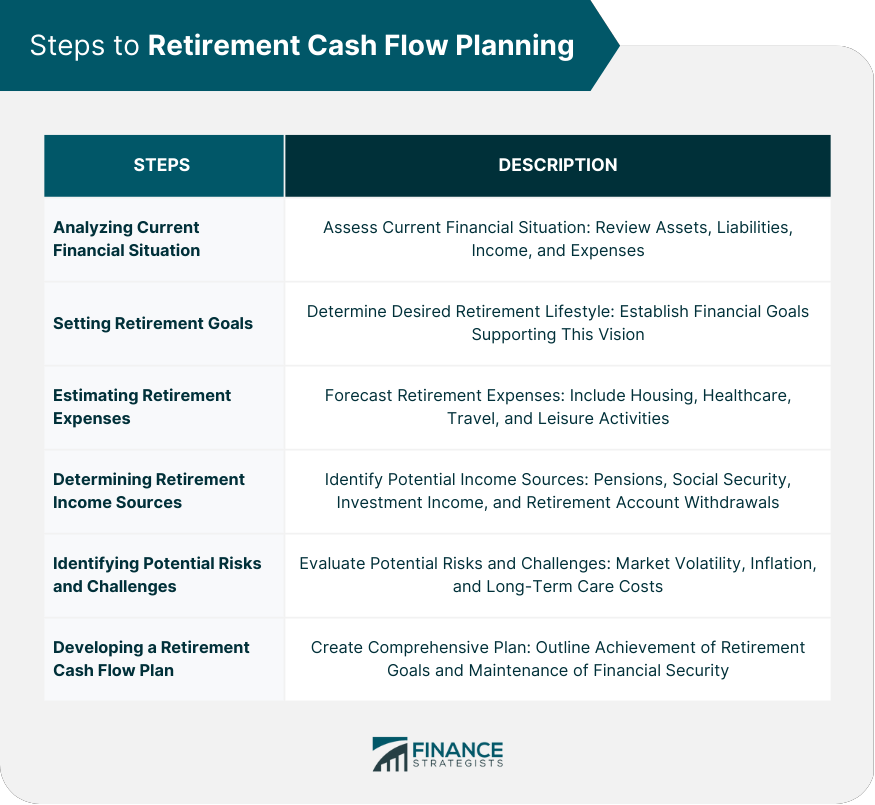
Common Retirement Cash Flow Planning Mistakes to Avoid
Underestimating Retirement Expenses
Some expenses may decrease after retirement, such as commuting costs, payroll taxes, or work-related spending. However, other costs may stay the same or increase.
Healthcare and long-term care costs can also rise later in retirement. If your spending estimate is too low, you may withdraw too much from your savings too early or find yourself short on funds later.
A realistic retirement budget should include both essential expenses and discretionary spending.Overestimating Retirement Income
Some retirees rely on overly optimistic investment returns, expected rental income, business income, pension benefits, or part-time work. Others may assume they will receive more from Social Security or retirement accounts than their plan can realistically support.
It is better to use conservative assumptions when estimating income. This can help prevent overspending and reduce the risk of running out of money.
A strong cash flow plan should show where income will come from, when it will begin, and how dependable each source is.Failing to Account for Inflation
Even modest inflation can make retirement more expensive over a 20- or 30-year period. Expenses such as food, insurance, utilities, housing, and healthcare may cost much more later in retirement than they do today.
Failing to account for inflation can make a retirement plan look stronger than it really is. Your income may seem sufficient in the early years but become stretched as prices rise.
A retirement cash flow plan should include inflation-adjusted expense estimates and income projections.Failing to Consider Healthcare Costs
Long-term care is another major consideration. Nursing home care, assisted living, and in-home care can be expensive and may not be fully covered by Medicare.
Planning for healthcare costs can help protect your retirement savings and reduce the chance of financial strain later in life.Over-Reliance on a Single Income Source
For example, depending only on Social Security, one pension, one rental property, or one investment account may leave you vulnerable if that income source changes, decreases, or becomes unreliable.
Diversifying retirement income sources can help create more stability. Potential sources may include Social Security, pensions, annuities, investment income, retirement account withdrawals, rental income, part-time work, or cash reserves.
A diversified income strategy can make your retirement cash flow more flexible and resilient.Conclusion
Retirement Cash Flow Planning FAQs
Retirement cash flow planning is a process of estimating your future expenses and income during your retirement years to ensure that you have enough money to cover your living expenses and maintain your lifestyle.
Retirement cash flow planning is important because it helps you understand whether you have enough money saved to maintain your lifestyle during retirement. It also helps you identify areas where you need to adjust your spending or savings to meet your retirement goals.
To start Retirement cash flow planning, you need to estimate your future expenses and income during retirement, including your expected Social Security benefits, pension payments, and any other sources of retirement income. You should also consider factors such as inflation, taxes, and healthcare costs.
Retirement cash flow planning strategies include saving as much as possible for retirement, creating a budget to control spending, maximizing Social Security benefits, and considering investment options such as annuities or mutual funds.
It is recommended to start Retirement cash flow planning as early as possible. The earlier you start, the more time you have to save and invest, and the more flexibility you have to adjust your retirement plans as needed. However, it is never too late to start planning for retirement cash flow.
True Tamplin is a published author, public speaker, CEO of UpDigital, and founder of Finance Strategists.
True is a Certified Educator in Personal Finance (CEPF®), author of The Handy Financial Ratios Guide, a member of the Society for Advancing Business Editing and Writing, contributes to his financial education site, Finance Strategists, and has spoken to various financial communities such as the CFA Institute, as well as university students like his Alma mater, Biola University, where he received a bachelor of science in business and data analytics.
To learn more about True, visit his personal website or view his author profiles on Amazon, Nasdaq and Forbes.