
A checking account is a type of deposit account designed for frequent transactions and daily money management. Unlike accounts intended primarily for saving, a checking account is meant to support regular deposits, withdrawals, purchases, transfers, and bill payments. It is often the first account people use to manage their financial lives because it serves as the main channel through which money enters and exits. In practical terms, a checking account usually comes with tools that make spending and money movement easy. These may include a debit card, online banking access, mobile deposit, direct deposit capability, check-writing privileges, and automated bill pay features. That combination makes a checking account less about storing wealth and more about providing smooth financial functionality. It is not simply a place where money sits. It is the operating account that keeps day-to-day finances moving. Whether you are swiping a debit card at a grocery store, withdrawing cash from an ATM, sending money electronically, or paying a bill online, the account is structured to make those actions fast and seamless. That ease of access is one of the main reasons checking accounts are such a foundational part of modern personal finance. This accessibility matters because everyday life depends on quick financial movement. Rent, gas, groceries, subscriptions, school expenses, and unexpected purchases often need to be paid immediately. A checking account supports that rhythm. It reduces the friction between having money and using money. For consumers who need constant access to funds, that convenience is not just helpful. It is essential. Most banks allow customers to set up automatic payments, transfer money to service providers, and use online bill pay systems directly through the account. This makes it possible to centralize recurring obligations in one place, which can reduce missed due dates and improve financial organization. For households juggling multiple monthly bills, a checking account can act as the command center for keeping everything current. That simplicity has a real impact on financial stability. When bills are paid from a single account on a predictable schedule, it becomes easier to monitor cash flow and avoid late fees. There is also a psychological benefit. Instead of handling each payment manually, account holders can create a more reliable system. A checking account supports not only transactions, but also routine and consistency, which are critical for strong money management. Another major advantage of checking accounts is their compatibility with direct deposit. Most employers, government agencies, and benefit providers prefer or require electronic deposits rather than paper checks. A checking account allows those funds to be deposited automatically, often making the money available faster than traditional check-cashing methods. In many cases, this speeds up access to wages and removes the inconvenience of physically depositing a check. Direct deposit also improves efficiency. It creates a predictable flow of money into the account, which can make budgeting and scheduling payments easier. Some institutions even offer early direct deposit features, giving customers access to funds before the official payday. While that should not replace careful budgeting, it can improve the timing of cash flow for those living on tight schedules. In this way, a checking account becomes more than just a tool for transactions. It becomes the anchor for incoming income. Keeping money in a checking account is generally much safer than carrying large amounts of cash. Physical cash can be lost, stolen, or damaged, and once it is gone, recovery may be impossible. By contrast, funds held in most checking accounts at banks and credit unions are protected by federal insurance up to applicable limits. On top of that, banks typically offer fraud monitoring, account alerts, card-lock features, and dispute resolution procedures that add another layer of protection. This safety matters because modern financial life includes risks that cash cannot handle well. If a debit card is lost, it can often be frozen or replaced. If fraudulent activity appears, the bank may investigate and potentially restore funds depending on the circumstances. That does not mean checking accounts are risk-free, but they provide far more structural protection than cash. For many consumers, that security is one of the most overlooked advantages of maintaining an account. Modern checking accounts increasingly function as digital financial dashboards. Many banks now provide mobile apps with real-time alerts, transaction histories, spending categories, remote check deposit, transfer tools, and customizable notifications. These features help customers track activity as it happens rather than waiting for a monthly statement. That immediacy gives people a better sense of where their money is going and how much remains available. These tools can also improve financial behavior. When you receive a low-balance alert or a notification the moment a charge posts, you are more likely to stay aware of your habits and avoid preventable mistakes. Some apps even integrate with broader budgeting tools, making it easier to understand spending patterns over time. A checking account, therefore, is no longer just a passive storage space. It can be an active part of how someone monitors and manages money on a daily basis. Some accounts charge monthly maintenance fees unless the customer meets specific requirements, such as keeping a minimum balance, setting up direct deposit, or making a certain number of transactions each month. Others charge for paper statements, out-of-network ATM use, or special account services. These fees may seem minor in isolation, but over time they can quietly erode a person’s finances. A monthly charge that feels insignificant can add up over the course of a year, especially for people already managing tight budgets. This is why the cost structure of a checking account matters so much. A checking account should make financial life easier, not become a recurring source of friction or loss. Consumers who fail to review the fee schedule may end up paying more for convenience than they expected. Overdrafts are one of the most costly and frustrating hazards associated with checking accounts. An overdraft occurs when a transaction exceeds the available balance in the account. Depending on the bank’s policies and the customer’s settings, the bank may either decline the transaction or allow it to go through and charge an overdraft fee. Those fees can be substantial, and multiple overdrafts in a short period can create a chain reaction that becomes difficult to recover from. This issue matters because checking accounts are designed for frequent use, and that use increases the likelihood of timing errors. A forgotten subscription, a pending charge that posts later than expected, or a miscalculated balance can all trigger an overdraft. For people living on the financial edge, this is especially dangerous. What begins as a small shortfall can quickly turn into an expensive problem. That is why overdraft policies deserve careful attention. A checking account may offer convenience, but convenience without awareness can become costly. Standard checking accounts usually pay little to nothing. While some banks offer interest-bearing checking accounts, the rates are typically modest and often require higher balances or other qualifying conditions. As a result, keeping large amounts of money in a checking account can create an opportunity cost, since those funds could potentially earn more in a savings account, money market account, or another low-risk vehicle. This limitation reflects the account’s intended purpose. A checking account is designed for movement, not growth. It prioritizes accessibility over yield. That tradeoff makes sense for money that needs to be available at a moment’s notice, but it becomes less sensible for funds that are meant to sit for weeks or months. Consumers who use checking accounts as their main holding place for all cash may sacrifice growth simply because the account is easy to use. Convenience, in this case, comes at the cost of earning potential. Another drawback is that some checking accounts require customers to maintain a minimum balance. If the account falls below that threshold, fees may be assessed or benefits may be lost. On paper, the requirement can appear manageable. In practice, however, it can be difficult for people with variable income, irregular expenses, or tight budgets to keep the balance consistently above the required amount. The result is that customers may feel pressured to keep more money in checking than they otherwise would. This can work against smart cash management. Instead of moving excess funds to savings or using money for other financial priorities, account holders may leave it sitting in checking simply to avoid a penalty. That weakens the overall efficiency of their money. A good checking account should fit the user’s financial patterns, not force the user into artificial behavior. When minimum balance rules become restrictive, the account may no longer be serving the consumer as effectively as it should. Checking accounts are not designed to build wealth over time. They are transaction platforms, which means their value lies in flexibility, access, and ease of use rather than in long-term financial growth. They do not typically provide competitive returns, and they do not encourage the kind of separation from spending that often helps people save more intentionally. Because the money remains easily accessible, it can be more tempting to spend rather than preserve. This makes checking accounts useful but incomplete. They are necessary for most people, yet they are only one part of a healthy financial system. Relying on a checking account alone can keep money in a constant state of motion without creating much progress. For that reason, checking accounts are best viewed as operational tools. They help manage day-to-day life, but they are not substitutes for savings, investing, or longer-term financial planning. The difference between checking and savings accounts comes down to purpose. A checking account is designed for frequent use, while a savings account is designed for storing money with less regular activity. Checking accounts prioritize liquidity and transaction speed. Savings accounts prioritize preservation and, in many cases, higher interest earnings. Neither is inherently better than the other. They simply serve different roles. For most people, the best approach is to use both. A checking account handles income, bills, and daily expenses, while a savings account holds money that is not immediately needed. This separation can improve discipline and make financial planning easier. When all money sits in a checking account, it is easier to overspend. When some money is deliberately set aside in savings, the financial system becomes more intentional and effective. Money market accounts can resemble checking accounts in some ways, especially when they allow limited check-writing or debit-style access. However, they are generally built to offer better returns in exchange for more restrictions or higher balance requirements. A checking account usually wins on convenience and flexibility, while a money market account often wins on yield. That distinction matters depending on how the money will be used. If the priority is fast, frequent access, checking is usually the better choice. If the priority is earning more while still maintaining a moderate degree of liquidity, a money market account may be worth considering. The decision depends less on the label of the account and more on the role the money plays in your financial life. Operating cash belongs in checking. Reserve cash may fit better elsewhere. Cash management accounts, often offered by brokerage firms or financial technology companies, are designed to blend features of banking and investing. They may provide debit cards, transfer tools, and high yields while also connecting seamlessly with brokerage or investment platforms. For consumers who want to keep their cash within a broader financial ecosystem, these accounts can be appealing alternatives to traditional checking accounts. Still, they are not identical to standard bank checking accounts. Some may have fewer traditional banking features, less branch access, or different customer service structures. For users who value integration and higher returns, that may be a fair trade. For others who want the familiarity and infrastructure of a conventional bank, a traditional checking account may still be preferable. The comparison is less about which account is universally better and more about which platform best matches the consumer’s habits and priorities. Choosing the right checking account starts with understanding the fee structure. Many accounts look similar on the surface, but the real differences often appear in the fine print. Monthly maintenance fees, overdraft charges, ATM costs, and service fees can all affect the true value of the account. A strong checking account should support your habits without creating avoidable expenses that chip away at your money over time. This means the best account is not always the one with the most features. It is the one whose rules fit how you actually use money. Someone who keeps a high balance and uses digital banking heavily may benefit from one type of account, while someone who needs frequent cash access may benefit from another. The right decision begins with honest self-assessment, not advertising claims. ATM access is another practical consideration that can significantly affect convenience and cost. If your bank has a broad in-network ATM system, it becomes much easier to withdraw cash without paying extra fees. If the network is limited, small withdrawal fees can add up over time, especially for people who use ATMs regularly. This is one of those details that seem minor until they become an everyday annoyance. The value of ATM access depends on lifestyle. Some people rarely use cash and may not care much about network size. Others rely on cash access frequently and should make it a priority. A checking account should fit your real patterns, not just look good on paper. Easy access to your own money remains one of the account’s central promises, so the ATM network matters more than many people initially realize. Digital features play an increasingly important role in how useful a checking account feels in everyday life. A strong mobile app, real-time alerts, mobile deposit, and easy transfer tools can make account management faster and more transparent. These features are not just conveniences. They can help people stay organized, avoid mistakes, and keep a closer eye on their financial behavior. The best digital experience is one that makes the account easier to control. A clunky app or limited online interface can add friction and reduce visibility into your finances. Because checking accounts are used so frequently, even small differences in technology can shape the overall customer experience. For many consumers today, digital quality is no longer secondary. It is one of the main criteria that determines whether an account feels effective. Minimum balance requirements should always be evaluated in light of your actual cash flow. An account that demands a certain balance may be manageable for some customers, but burdensome for others. If maintaining that threshold requires constant effort or distorts how you use your money, the account may not be the right fit. Financial tools should support stability, not create pressure. An ideal checking account allows you to use your money naturally while avoiding unnecessary penalties. If you are regularly close to the threshold, even a well-designed account may feel stressful. That is why flexibility matters. The right account is one you can maintain comfortably, not one you are always trying to keep from becoming expensive. Customer support remains important even in an increasingly digital banking environment. Problems happen. Cards are lost, transactions are disputed, transfers are delayed, and logins fail. In those moments, responsive support can matter more than any advertised perk. Some customers prefer in-person branch assistance, while others are comfortable with phone, chat, or app-based service. What matters is whether help is accessible when you need it. A checking account is part of the infrastructure of your financial life. If something goes wrong, the quality of support becomes part of the account’s value. Accessibility is not just about branch locations. It is about whether the institution feels dependable. That kind of reliability is difficult to measure in advance, but it should still be part of the decision-making process. A checking account is one of the most useful tools in personal finance, but its value depends on how it is used. It offers convenience, flexibility, and immediate access to money, making it ideal for everyday spending, bill payment, and direct deposit. Those advantages explain why it is a standard part of most people’s financial lives. It keeps cash flow organized and makes routine transactions far easier to manage. But convenience has limits. Fees, overdraft risk, low interest, and weak long-term growth potential all remind us that a checking account is not meant to do everything. It is best used as a daily operating account, not as the main place for building savings or preserving wealth over time. When paired with other financial tools and chosen carefully, a checking account can be extremely effective. The real key is understanding its role clearly: it is built for movement, access, and control, not for growth.What Is a Checking Account?
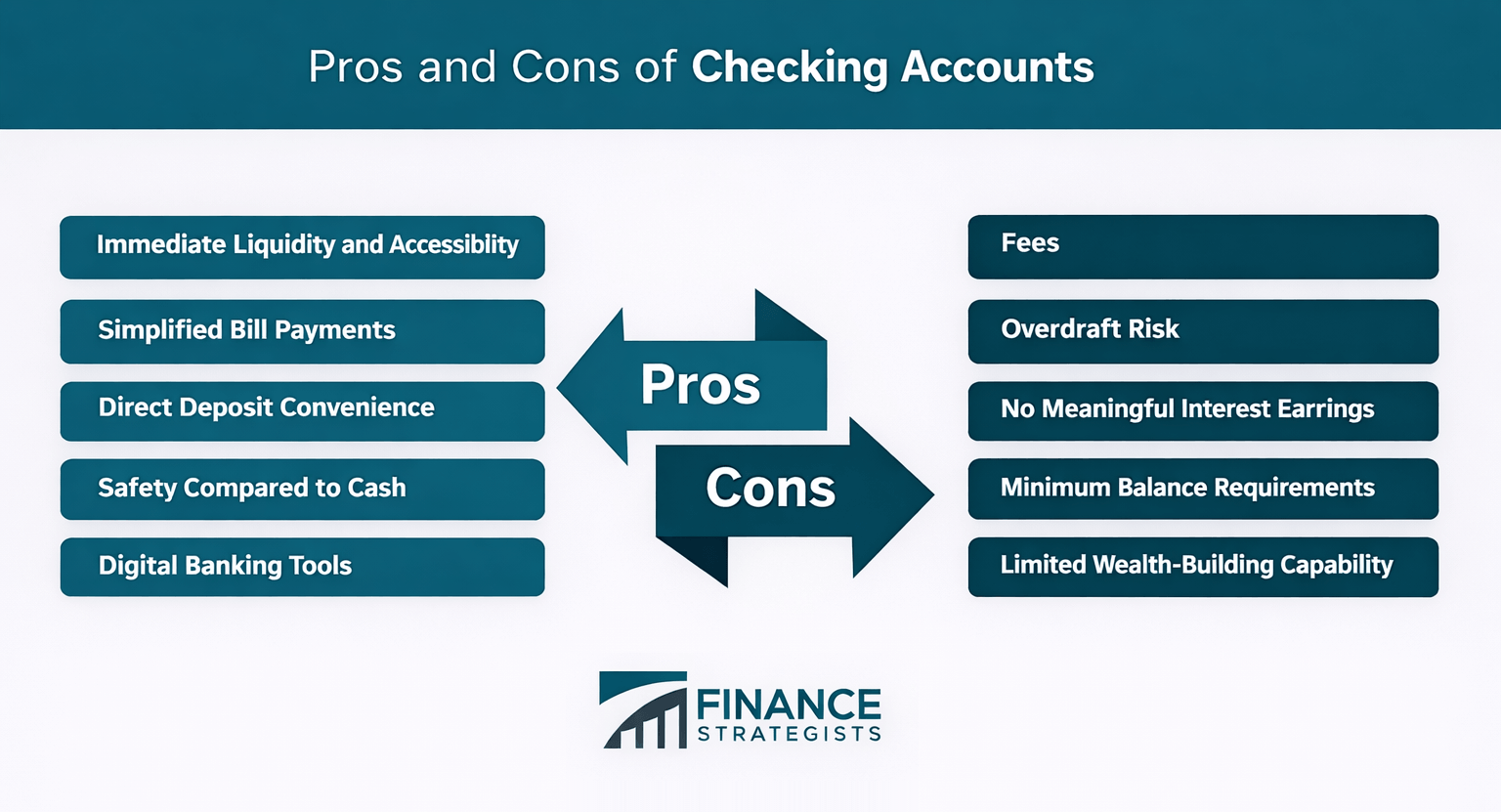
Pros of Checking Accounts
Immediate Liquidity and Accessibility
Simplified Bill Payments
Direct Deposit Convenience
Safety Compared to Cash
Digital Banking Tools
Cons of Checking Accounts
Fees
Overdraft Risk
No Meaningful Interest Earnings
Minimum Balance Requirements
Limited Wealth-Building Capability
Checking Account Vs Other Financial Accounts
Checking Vs Savings Accounts
Checking Vs Money Market Accounts
Checking Vs Cash Management Accounts
How to Choose the Right Checking Account
Fee Structure Evaluation
ATM Access and Network Size
Digital Banking Features
Minimum Balance Requirements
Customer Support and Accessibility
The Bottom Line
Checking Account Pros and Cons FAQs
Checking accounts are generally safe when held at insured financial institutions. In addition to federal insurance protections, many banks and credit unions offer fraud detection systems, secure login tools, and account monitoring features that can help reduce risk. While no account is immune from fraud or misuse, checking accounts provide far more protection than holding large amounts of cash.
A checking account is appropriate for almost anyone who needs to manage routine financial activity. It is especially useful for people who want a centralized place to receive deposits and cover expenses, but it works best when paired with other tools for saving and growth.
Some checking accounts do pay interest, but the amount is often limited and may depend on meeting certain requirements. For consumers focused on maximizing returns, a checking account is usually not the best place to keep large balances. It is more accurate to view any interest earned as a small bonus rather than a core advantage.
If you overdraft your account, the outcome depends on your bank’s policies and settings. The transaction may be declined, or it may go through and trigger an overdraft fee. In either case, overdrafts can disrupt your finances and become expensive, especially if they happen repeatedly. Monitoring your balance closely is one of the best ways to avoid this problem.
A checking account is not legally required in most cases, but it is highly practical for managing modern financial life. Receiving income, paying bills, making purchases, and sending money are all much easier with a checking account. For most people, it functions as a necessary tool even if it is not technically mandatory.
True Tamplin is a published author, public speaker, CEO of UpDigital, and founder of Finance Strategists.
True is a Certified Educator in Personal Finance (CEPF®), author of The Handy Financial Ratios Guide, a member of the Society for Advancing Business Editing and Writing, contributes to his financial education site, Finance Strategists, and has spoken to various financial communities such as the CFA Institute, as well as university students like his Alma mater, Biola University, where he received a bachelor of science in business and data analytics.
To learn more about True, visit his personal website or view his author profiles on Amazon, Nasdaq and Forbes.